
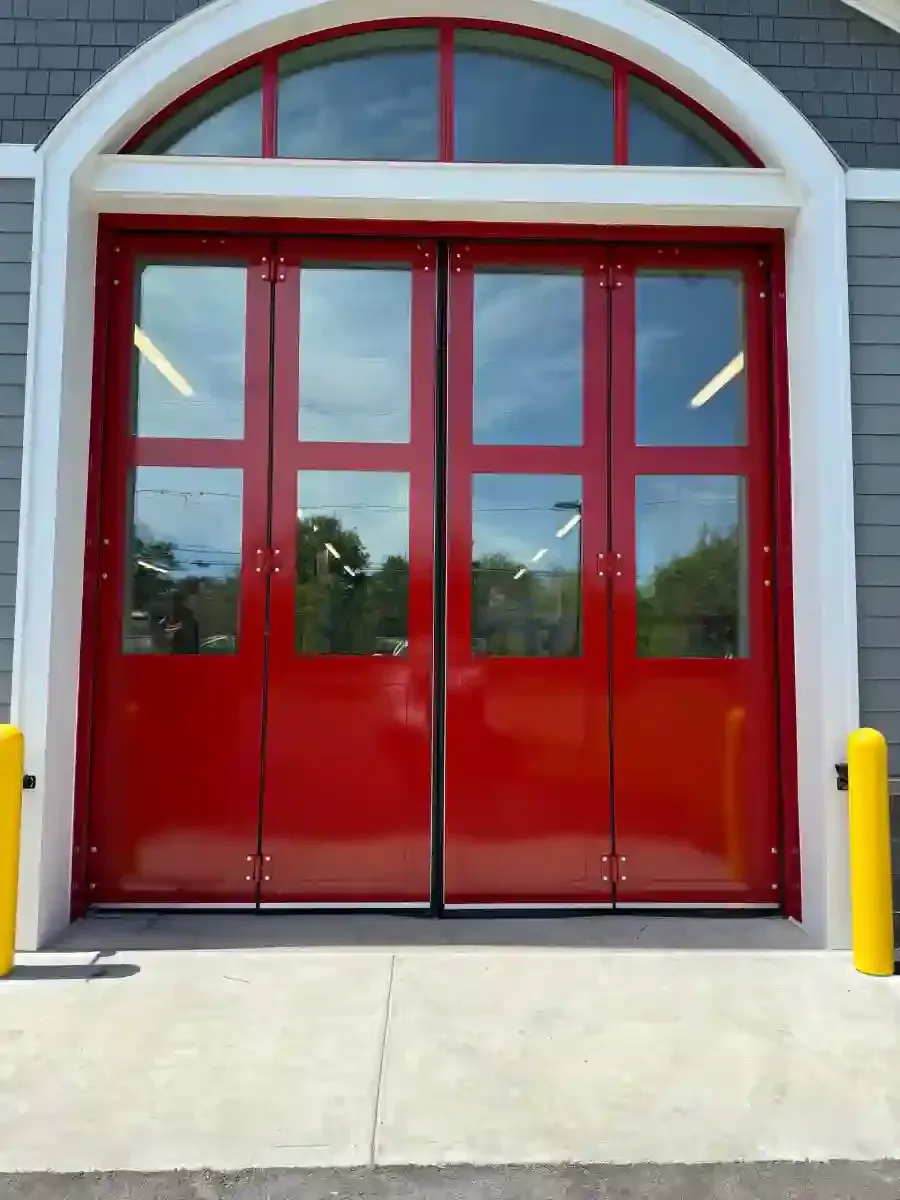
Large-Opening Systems Without Standard Door Limitations
Four fold door installation in Taunton for aviation hangars, auto dealerships, and oversized commercial bays requiring fold-away clearance
Track geometry and pivot pin placement determine whether a four fold door operates reliably or binds under thermal expansion during summer heat—a failure mode specific to fold door systems that doesn't affect sectional or rolling steel designs. Aviation hangars and large commercial facilities along the Route 44 corridor and East Taunton industrial areas require fold-away door clearance that standard sectional doors cannot provide, and Next Generation Doors & Construction installs four fold doors for applications where opening width or overhead clearance makes conventional systems impractical. When pivot pins are positioned correctly relative to panel weight distribution, the door folds and unfolds without binding, even when summer temperatures cause steel panels to expand by measurable amounts.
Four fold door systems consist of multiple panels connected by hinges that allow the door to fold back against the jamb or into a side pocket, clearing the entire opening without requiring overhead track space. This design works for aircraft hangars where ceiling clearance is needed for tail height, and for auto dealerships where showroom aesthetics require minimal visible hardware. The challenge lies in calculating pivot pin locations—if the pins don't align with the panel's center of gravity as it swings through the fold sequence, friction increases and the door binds partway through operation.
Request a site assessment to evaluate your opening dimensions and confirm whether a four fold system meets your clearance requirements.
Why Track Geometry Determines Operational Reliability
Installation requires mounting the top track so that it accommodates panel swing radius without interference, positioning pivot pins at calculated intervals based on panel weight and hinge count, and verifying that the door folds evenly on both sides. Track geometry must account for the arc each panel travels as it folds—if the track radius doesn't match the calculated swing path, the panels jam against the track or each other. Eastern Massachusetts' summer heat causes steel panels to expand lengthwise, and if the track doesn't include clearance for that expansion, the door binds when outdoor temperatures exceed 85 degrees.
After installation, the door folds smoothly into its storage position without manual force, panels stack parallel to each other without gaps or overlaps, and the system operates consistently regardless of seasonal temperature changes. This performance depends on installation precision that accounts for thermal expansion factors—something general garage door contractors typically don't calculate when installing four fold systems.
The service includes track system installation, pivot pin positioning, panel hanging and alignment, and operational testing under load. It does not include structural reinforcement of the header or jamb, which is assessed separately if the opening requires additional support. IDA certification ensures that the installation follows manufacturer specifications while incorporating the adjustments necessary for large-opening applications where standard installation practices don't apply.
What Facility Managers Need to Know
Facility operators considering four fold door installation typically have questions about system capabilities and long-term performance.
What makes four fold doors different from sectional or rolling steel systems?
Four fold doors fold back on themselves rather than rolling up or traveling along overhead tracks, which makes them suitable for applications where overhead clearance is limited or where the full opening width must remain unobstructed. This design requires more complex pivot and hinge systems than sectional doors, but delivers clearance that other systems cannot achieve.
How does thermal expansion affect four fold door operation in Eastern Massachusetts?
Steel panels expand in summer heat and contract in winter cold—this changes the panel length by enough to cause binding if the track system doesn't include clearance for expansion. Proper installation accounts for this movement by positioning the track with expansion gaps and ensuring pivot pins have tolerance for length changes without increasing friction.
What clearance is required for four fold door installation?
Clearance requirements depend on panel width and fold configuration, but most four fold systems require side clearance equal to the stacked panel width plus six inches for hardware. Overhead clearance must accommodate the top track and hanging hardware, typically twelve to eighteen inches depending on door height.
When is a four fold door the right choice over a sectional door?
Four fold doors are appropriate when overhead clearance is insufficient for sectional door tracks, when the full opening width must remain clear during operation, or when aesthetic requirements favor a door that folds out of sight rather than rolling overhead. Aviation hangars, fire stations with tall vehicles, and showrooms with high ceilings are common applications.
How long does four fold door installation take for a commercial hangar?
Installation duration depends on door size and structural preparation requirements, but most single-bay installations are completed within two to three working days. Multi-panel systems with custom configurations require longer installation timelines and often involve coordination with other trades for electrical or structural work.
Next Generation Doors & Construction brings nearly two decades of specialty commercial door experience to four fold door installations across Taunton and Eastern Massachusetts, with IDA certification ensuring that every installation handles the complex clearance and structural demands these systems require. Arrange a facility consultation to determine whether your application suits a four fold configuration and what structural preparation your opening requires before installation.